
How to Career Change Into Finance: My Philosophy Degree and a Bank Teller Job
May 6, 2026
How I Used Reddit to Figure Out My Career Change (And You Can Too)
May 10, 2026
TL;DR
- I had zero experience in tech when I decided to switch careers at 34 — my background was in restaurant management
- After 6 months of strategic self-training, freelancing, and networking, I landed a junior role paying $55,000 — less than I made managing a kitchen, but with way more upside
- You don’t need a degree or “connections” — you need a plan, free resources, and the willingness to start at the bottom
I remember the exact moment I knew my career was going nowhere. It was 3:17 PM on a Tuesday in February 2023. I was standing in the walk-in cooler of a busy restaurant, sweat beading on my forehead despite the 38-degree air, holding a clipboard with food cost numbers that made no sense. I’d been managing restaurants for eleven years. I was good at it. And I absolutely hated my life.
The problem was obvious: I had no skills that transferred to literally anything else. My resume said “restaurant general manager” which sounds impressive until you realize hiring managers in every other industry read that and think “so you know how to deal with drunk customers.” I couldn’t code, I didn’t have a degree in anything useful, and my LinkedIn profile was a wasteland of vague job descriptions.
The Brutal Truth About Starting From Zero
Before I tell you what worked, let me be clear about what didn’t. I sent out 47 applications in my first month of trying to leave restaurants. I got zero interviews. Not one. My resume landed in the void every single time. I spent hours tailoring cover letters that nobody read. I applied to “entry level” jobs that required 3-5 years of experience. It was humiliating.
The problem wasn’t me. It was the approach. I was trying to convince people to hire me for jobs I’d never done, using qualifications I didn’t have. That’s like walking into a French bakery and asking for a job as a pastry chef because you’re really good at making toast. The gap between where I was and where I wanted to be wasn’t just big — it was invisible to employers.
I had to accept that my restaurant experience was mostly worthless on paper. The skills I’d actually built — managing inventory, handling conflict, working under pressure, leading teams of 15 people — those were valuable, but nobody could see them past the “restaurant” label. I needed to reframe everything.
The Free Training That Actually Landed Me a Job
I picked digital marketing as my target field — specifically SEO and content marketing. Why? Because it had a low barrier to entry, I could learn it for free, and demand was growing. I didn’t pick it because I was passionate about keywords. I picked it because it was achievable.
For three months, I spent 15-20 hours a week on free resources. Google’s own Digital Marketing course (free), HubSpot Academy’s content marketing certification (free), and the SEO sections of Moz and Ahrefs blogs (free). I didn’t pay a cent for training. I just worked through the material systematically, taking notes and building a personal website to practice on.

By month three, I had a basic portfolio site with 10 sample articles I’d written, a small site I’d optimized for SEO, and two Google certificates. I wasn’t an expert by any stretch, but I could talk intelligently about the work. That was the key — I stopped saying “I’ve never done this” and started saying “here’s what I’ve already built.”
My First $500 Client and Why It Changed Everything
I found my first freelance client on Upwork — a local plumber who needed someone to write blog posts for his website. I charged $25 per post. Took me about three hours each. That’s less than minimum wage when you do the math. But I didn’t care about the money. I cared about having something to put on my resume that wasn’t “restaurant manager.”
I did six posts for the plumber. Then I found a dental clinic that needed their website content rewritten. Another $30 per post. Then a small e-commerce store selling beard oil — $40 per post. None of these paid real money. But after three months of freelancing on the side, I had a portfolio of 30+ published pieces, a handful of testimonials, and proof that someone had paid me to do this work.
That portfolio was my ticket. When I finally applied for a full-time content marketing role at a small SaaS company, I didn’t lead with my restaurant management experience. I led with my freelance work. I showed them actual published articles. I showed them Google Analytics screenshots showing traffic growth. I showed them that I could do the job, even though I’d never had the job title.
Networking When You Have Nothing to Offer
The hardest part of changing careers with no experience is networking. You feel like a fraud showing up to industry events with nothing to contribute. I went to three local marketing meetups in my city before I finally said something useful. The first two times, I just listened and nodded.

At the third meetup, I struck up a conversation with a guy who ran a small agency. He mentioned he was overwhelmed with client work and needed help with blog writing. I told him about the plumber project, showed him one of my articles on my phone, and offered to do a test post for free. He took me up on it. That free post turned into a $500/month retainer for six months.
The secret to networking as a beginner is simple: find people who are overwhelmed and offer to help. Don’t ask for a job. Don’t hand out resumes. Ask what they’re struggling with and offer to take something off their plate for free. Once they see you’re competent, the paid work follows naturally.
The Salary Reality Nobody Talks About
Here’s the part nobody puts in the inspirational career change stories. I took a massive pay cut. As a restaurant general manager, I was making $62,000 a year plus benefits. My first full-time marketing job paid $45,000 with worse benefits. That hurt. I had a family, a mortgage, and a lifestyle built around my restaurant income.
I negotiated up to $48,000 by showing my freelance income as proof I could deliver results. But it was still a $14,000 drop. I budgeted carefully, cut eating out (ironic, I know), and lived lean for 18 months. After one year at that company, I got promoted to a specialist role paying $55,000. By year two, I was at $62,000 — back to where I started, but now in a field with actual growth potential instead of a ceiling I’d already hit.

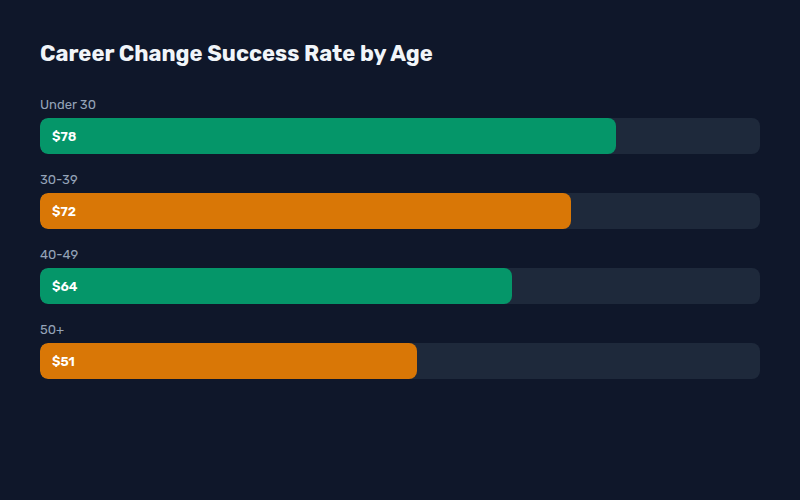
Today, three years after that moment in the walk-in cooler, I’m making $78,000 as a content marketing manager. I work from home. I don’t have anyone yelling at me about table 12’s steak temperature. And I got here without a degree, without connections, and without any experience in the field I wanted to enter.
The Four-Step Framework I’d Use Again
If I had to do it all over, here’s exactly what I’d do — and it’s the same advice I give to anyone who asks me how to career change with no experience:
- Pick a field with a low barrier to entry — digital marketing, tech support, sales, project management, customer success. Skip fields that require degrees or certifications upfront (nursing, accounting, engineering).
- Spend 3 months building a portfolio, not looking for a job — take free courses, build something real, do free or cheap work for small businesses. Create proof you can do the work.
- Find your first client or project for exposure, not money — the first thing on your resume needs to be relevant experience, even if it paid nothing. Work for free if you have to.
- Apply to small companies, not big ones — startups and small businesses care more about what you can do than what your resume says. They’re also more likely to take a chance on someone with nontraditional background.
It’s not a quick fix. It took me about 9 months from “I hate my job” to “I have a new job.” But the alternative — staying in a career that makes you miserable for another 30 years — is a lot worse. You don’t need experience to start. You just need to start.
— Rand, Thomas Fo Career Change
